The Infinity Castle Explained: Nakime’s Endless Fortress
Picture a door that opens into a room, then another door that opens into a different room, then another, with no end in sight. Walls slide, floors tilt, and the ceiling of one room can suddenly become the floor of the next. That strange, shifting place is the Infinity Castle, one of the most memorable locations in Demon Slayer. It is not a normal building. It is a living maze, shaped by a powerful demon, and it becomes the stage for the final battle of the series. Readers who follow Demon Slayer Manga will find that the castle is more than a backdrop. It changes how fights happen, who meets whom, and how much danger each fighter faces.
This guide explains the castle in simple terms: what it is, how it works, why it never seems to end, and why it matters to the story. You do not need deep knowledge of every arc to follow along. If you know the basics of demons, slayers, and the Demon Slayer Corps, you already have enough background.
What Is the Infinity Castle?
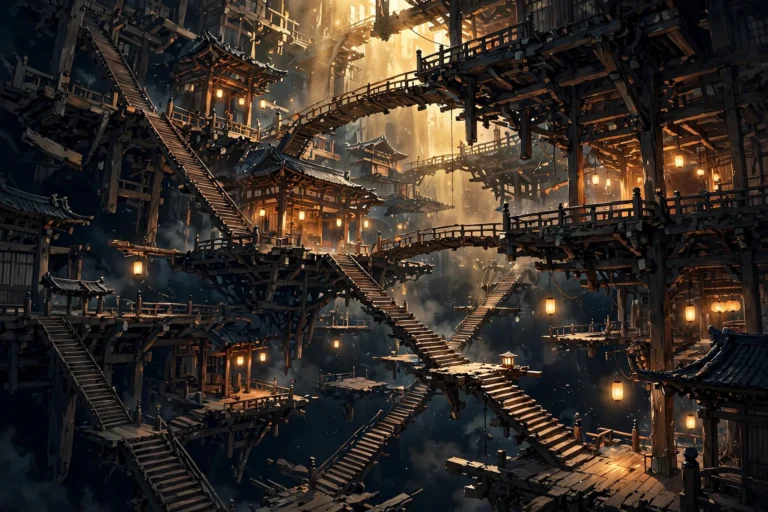
The Infinity Castle is a vast, hidden stronghold connected to Muzan Kibutsuji, the first and strongest demon. It looks like an endless collection of traditional Japanese rooms, corridors, stairways, and sliding doors. Wooden beams cross overhead, paper screens glow faintly, and tatami floors stretch in every direction. Yet nothing stays still for long. Rooms can move apart, turn upside down, or slide into new positions as if the whole building were breathing.
Ordinary people cannot simply walk in from a street. The castle exists apart from normal places, reached only through means tied to demon power. That separation makes it an ideal refuge for Muzan and his closest followers. Inside, they can meet, plan, and hide without being found by the Corps. It also gives them an advantage in a fight, because visitors do not know the layout, and the layout can change while they are standing in it. For a fuller look at the battle that takes place there, see the Infinity Castle arc guide.
Who Shapes the Castle?
The castle is shaped by Nakime, a demon whose power is tied to music. She plays a biwa, a short necked lute, and each note can move a room, open a passage, or send a person to a different part of the fortress. Think of her instrument as a remote control for the entire building. One strum can separate two fighters. Another can bring two enemies face to face. A third can drop a slayer into a dark corridor far from help.
This control is linked to the wider system of demon powers, explained in the guide to Blood Demon Arts. Nakime’s art is unusual because it does not attack directly with claws, fire, or poison. Instead, it controls space itself. She does not need to win a sword fight. She only needs to decide where each fight happens. Her place among the Twelve Kizuki reflects that value, since her power protects the castle and serves Muzan directly. For more detail, see the companion piece on Nakime, the demon who controls the Infinity Castle.
Why Does the Castle Never End?
The castle feels endless for three reasons. First, its rooms are not fixed in one plan. New arrangements can appear as old ones close off, so a person who walks in a straight line may still end up somewhere unexpected. Second, direction itself becomes unreliable. Up, down, left, and right lose their normal meaning when a room flips or slides sideways. Third, the castle is large beyond normal scale. Even without movement, it would take a long time to search, and with movement, a full search becomes almost impossible.
- Moving rooms: walls and floors slide into new positions at speed.
- Broken directions: stairways can lead up, down, or sideways without warning.
- Separated fighters: allies can be split apart in seconds, even if they entered together.
- Hidden depths: dark corridors and closed doors suggest rooms that are never fully shown.
How the Castle Changes Every Battle
Most battles in Demon Slayer depend on skill, speed, breathing technique, and teamwork. The Infinity Castle adds a fifth factor: the room itself. A slayer who is winning a duel can suddenly be thrown into a new chamber, alone, facing a different opponent. A demon who is losing can vanish through a sliding wall and return later. Support from friends becomes hard to give, because friends may be rooms away, with no clear path between them.
This is why the castle arc feels so intense. The Hashira, the nine pillars of the Demon Slayer Corps, are the strongest slayers, yet even they cannot control the battlefield here. They must adapt fast, read each new room, and fight without knowing what will shift next. Their strength still matters, but their awareness matters just as much. The second part of the story raises the stakes further, as covered in the guide to Demon Slayer Infinity Castle Part 2.
What Does It Feel Like Inside?
The castle creates a dreamlike, uneasy mood. Light is dim, shadows stretch across wood and paper, and sound travels oddly, so a footstep can seem near and far at once. Silence feels heavy, because the next note from the biwa may change everything. The design borrows from traditional Japanese architecture, which makes the strangeness feel grounded. These are familiar rooms and doors, yet they behave in impossible ways, and a room that turns upside down breaks the basic rules of the world.
Why the Castle Matters to the Whole Story
The Infinity Castle is the point where hiding ends and direct confrontation begins. For much of the series, Muzan stays in the shadows, protected by distance, secrecy, and powerful followers. When the Corps finally enters it, the story moves to a single, decisive struggle, with no easy retreat, no simple map, and no promise that help will arrive in time. The castle also tests courage, loyalty, and adaptability: staying steady when the world keeps changing, and adjusting to a room that may flip or vanish.
After the castle arc, the story moves toward its closing phase, including the Sunrise Countdown arc. The castle sets up that ending by forcing every major fighter into the open and by removing the safety of distance. To understand Muzan himself, and why his defeat matters so much, see the guide to Muzan Kibutsuji. His power, his followers, and his fortress all work together, and the castle is the clearest symbol of his control.
What to Remember About the Infinity Castle
If you remember only a few points, let them be these. The Infinity Castle is a vast, shifting fortress tied to Muzan. Nakime controls its rooms through her biwa, moving walls, doors, and fighters with music. Its endless layout breaks normal directions and splits allies apart, turning the final arc into a test of calm and adaptability as much as sword skill. That is why the battle there feels so uncertain, so tense, and so hard to forget.