Blood Demon Arts Explained: How Demon Powers Work
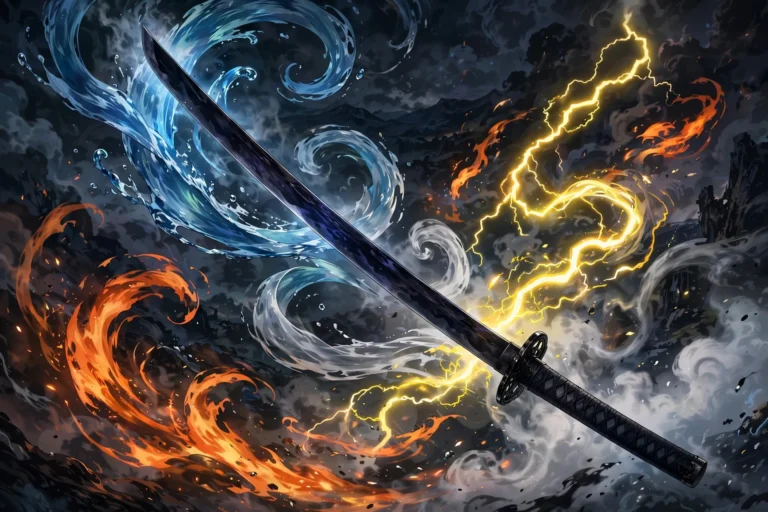
Every demon in Demon Slayer is strong, fast and hard to kill. Only some of them can also flood a room with ice, turn their blood into blades, or rebuild an entire fortress with a musical instrument. Those extra powers are Blood Demon Arts, the supernatural techniques that separate an ordinary demon from a true monster. This explainer covers where these arts come from, why no two are alike, and the limits that even they cannot break.
What Exactly Is a Blood Demon Art?
A Blood Demon Art is a unique power that awakens inside a demon’s blood. It is not taught and it cannot be copied from another demon. The technique grows out of the individual, so it often reflects the life that demon lived as a human. A courtesan’s art twists silk sashes into blades. A drummer’s art turns the beats of his drums into rotating rooms. A demon who painted with pots made pots that store and crush his prey. Because each art is personal, slayers walk into every serious fight partly blind: they know the demon has something, but not what, until it is used on them.
How Does a Demon Gain One?
New demons have no art at all, only claws, strength and regeneration. An art develops as a demon grows stronger, mainly by eating more humans and by carrying more of Muzan Kibutsuji’s blood. The more of his blood a demon holds, the greater the power available to shape. This is why the Twelve Kizuki, who received the largest shares, display the most extreme techniques in the series. Age alone is not enough either. A demon who hides for a century and eats rarely may never awaken an art, while one fed generously on Muzan’s blood can grow a terrifying power within decades. It is also why Muzan guards his blood carefully and destroys demons who displease him: he is not just their creator, he is their fuel supply.
Famous Blood Demon Arts at Work
- Rui’s threads: the Lower Rank Five demon spins threads from his cells that are tougher than steel, and can harden them further with his own blood until they slice through swords.
- Enmu’s dreams: the Lower Rank One demon puts victims to sleep and enters their dreams, hunting for the spiritual core whose destruction would leave the body an empty shell.
- Daki’s obi: living sashes stored inside her body slash, grab and trap people, and can even store victims inside the cloth.
- Akaza’s Compass Needle: the Upper Rank Three demon reads an opponent’s fighting spirit like a compass, sensing attacks before they land, including ones aimed at his blind spots.
- Hantengu’s clones: fear splits this Upper Rank Four demon into emotion clones, anger, joy, sorrow and pleasure, each wielding its own elemental attack.
- Doma’s ice: the Upper Rank Two demon freezes his own blood into glittering ice, shaping statues, clones and clouds of frost that shred the lungs of anyone who breathes them in.
- Kokushibo’s crescents: every swing of the Upper Rank One demon’s blade releases countless crescent moon blades of shifting size and direction, leaving no safe line to pass through.
- Nakime’s fortress: with notes from her biwa, she rearranges the entire Infinity Castle, moving rooms, doors and gravity itself.
The One Art That Burns Only Demons
The strangest art in the series belongs to a demon who refuses to eat humans. Nezuko Kamado’s Exploding Blood ignites her own spilled blood into flames that burn demon flesh, demon cells and even demon techniques, including poisons working through a victim’s body. Human flesh is untouched by it. Her flames have saved slayers mid-battle by burning away enemy arts, and her brother has learned to let those flames ride along his own blade, burning demons that his steel alone cannot finish. The allied demon doctor Tamayo shows a gentler version of the same principle: her blood carries scent-based spells that bewitch the senses, while her assistant Yushiro uses an art of sight, hiding and revealing things through paper talismans.
What Are the Limits of a Blood Demon Art?
Arts are powerful, but they run on the demon’s own body. Every thread, clone and sash is made from the demon’s blood and flesh, so heavy use competes with the regeneration that keeps the demon alive. An art also cannot erase the basic weaknesses every demon carries: sunlight still turns them to ash, wisteria still poisons them, and a Nichirin blade through the neck still ends the fight, as our guide to the three great weaknesses of demons explains in full. Some arts depend on an outside anchor as well. Enmu fused his body into a train, so cutting the train’s true neck ended both the machine and the demon. Destroy the anchor, and the whole technique can collapse with it. Finally, an art is fixed once it awakens. A demon cannot simply invent a counter to whatever beats it, which is why experienced slayers aim to survive the first exchange, read the rules of the art, and then take it apart.
Why Blood Demon Arts Decide the Biggest Fights
Strip away the spectacle and a Blood Demon Art is the point where a demon stops being a stronger animal and becomes a puzzle with a body count. The corps’ whole approach to elite demons, from Demon Slayer Manga guides to the Hashira’s own tactics, starts from one fact: raw strength can be matched with training, but an unknown art has to be understood before it can be beaten, and understanding it usually costs blood first.